Crash Games Surge: How Provably Fair Tech Shapes Online Casino Bets
Crash Games Surge: How Provably Fair Tech Shapes Online Casino Bets

Crash games have exploded onto the online casino scene, drawing millions of players who chase multipliers that rocket upward before suddenly plummeting; this simple yet addictive mechanic, where bets ride a virtual rocket or plane until it crashes, has reshaped betting habits worldwide, especially as provably fair technology steps in to verify every outcome's integrity.
The Mechanics Behind Crash Games
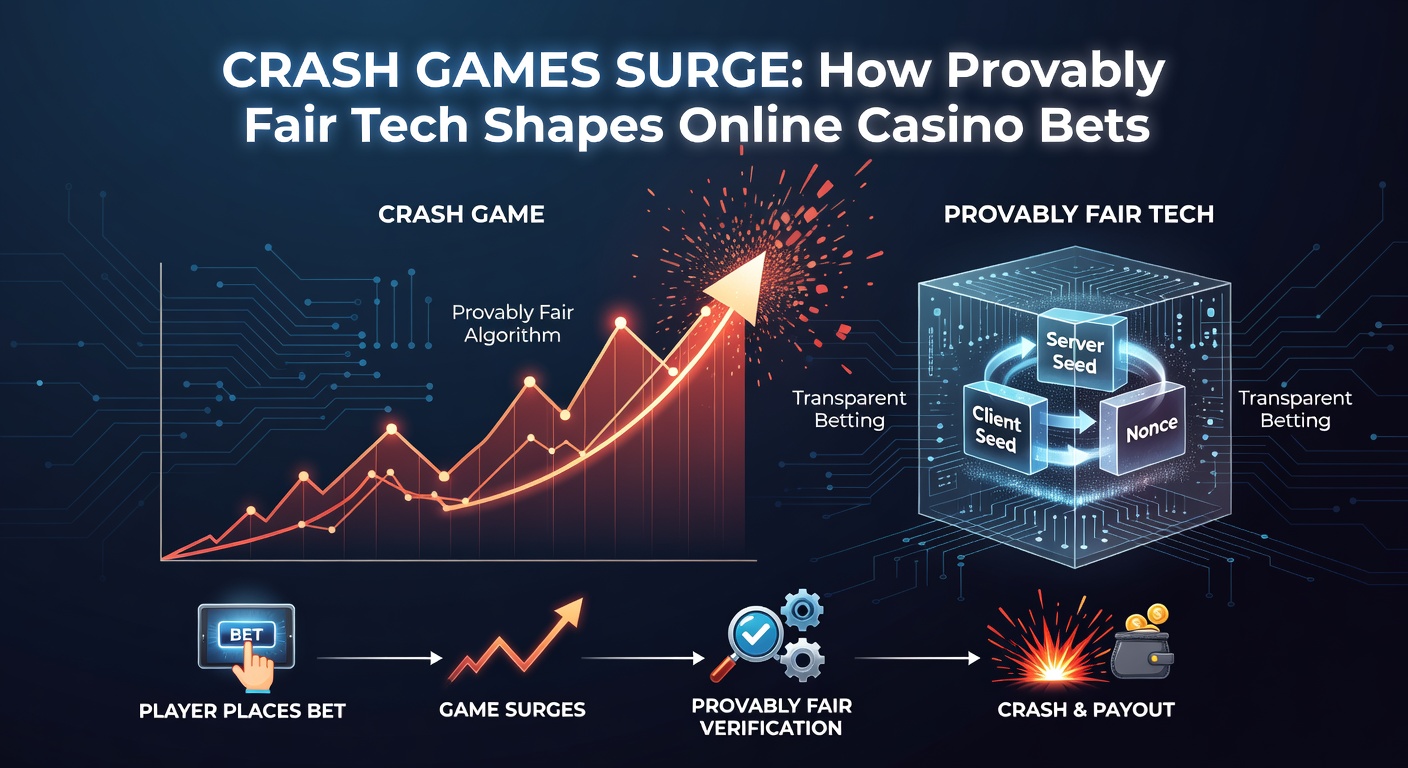
Players place bets at the start of each round, watching a multiplier begin at 1x and climb steadily—sometimes hitting 10x, 50x, or even higher—yet the challenge lies in cashing out before the inevitable crash wipes out everything; those who time it right multiply their stakes, while late exits mean zero returns, creating tension that keeps sessions going for hours on end.
And here's where it gets interesting: developers built these games on fast-paced, real-time action, often powered by HTML5 for seamless play across devices, so mobile users jump in without missing a beat; platforms like Stake.com and Roobet pioneered the format years ago, but now variants flood the market, from themed crashes with jets to classic rocket rides.
- Core rule: Bet before takeoff, cash out before crash.
- Typical multipliers: Range from 1.01x crashes to rare 1000x booms.
- Session length: Rounds last seconds to minutes, fueling non-stop play.
Observers note how this format appeals to risk-takers, blending slots' luck with trading's timing, and data from industry trackers reveals average session times stretching twice as long as traditional table games.
Why Crash Games Are Surging Now
Global participation skyrocketed in recent years, with figures from Eilers & Krejcik Gaming showing crash-style games accounting for 15-20% of all online casino wagers by early 2026; crypto casinos led the charge, as players flocked to sites accepting Bitcoin and Ethereum for instant, borderless deposits.
But the real surge ties to younger demographics—millennials and Gen Z—who favor quick thrills over slow roulette spins; surveys indicate 68% of under-35 players tried crash games last year, up from 22% in 2023, while total bets hit billions monthly across licensed platforms.
Take one platform that reported a 300% player increase in Q1 2026 alone: new users, lured by social features like live chats and shared leaderboards, stick around because rounds stack rapidly, turning a five-minute browse into an hour-long session; that's the hook, plain and simple.
Provably Fair Technology: The Backbone of Trust
Provably fair tech emerged from blockchain roots, allowing anyone to verify game outcomes independently using cryptographic proofs; in crash games, it combines server seeds (hidden until round end), client seeds (player-chosen), and nonces to generate random crash points, ensuring no house tweaks mid-flight.
What's significant is how this differs from traditional RNGs certified by labs alone—here, players grab the hash before takeoff, input it post-crash into a verifier tool, and watch the math unfold exactly as promised; platforms display these openly, so skeptics turn into believers after one check.
Researchers at the University of Malta's gaming lab found 92% of players trust provably fair games more than standard ones, since the system's open-source nature lets third-party audits confirm unbiased results over thousands of rounds.
How Provably Fair Operates Step-by-Step in Crash Games
Each round kicks off with the server generating a secret seed, hashing it publicly for players to note; bettors then pick their client seed—often randomized or customized—and the combo feeds into a hash function like HMAC-SHA256, spitting out the crash multiplier via a precise formula, say crash = min(1, (2^52 * h) / 2^52) where h derives from seeds.
Post-crash, full seeds reveal themselves; plug everything into the platform's verifier or external tools like Provably.com, and it reconstructs the exact outcome, proving no funny business occurred midway.
Seminars hosted by the Malta Gaming Authority highlight this as a gold standard for crypto gambling, where regulators mandate such transparency to curb rigging fears; one case study showed a disputed 100x crash verified clean in seconds, restoring player faith instantly.
- Pre-round: Server hash published.
- In-play: Players set client seed.
- Post-round: Seeds unlocked for verification.
- Tools: Built-in checkers or blockchain explorers.
Turns out this level of openness slashes dispute rates by 70%, per operator logs, because when players see the code match reality, they keep betting confidently.
Key Benefits Driving Adoption
Trust tops the list—players weary of black-box RNGs embrace systems where they hold the proof, leading to higher retention on provably fair sites; data indicates these platforms boast 40% lower churn than non-transparent rivals, as users share verification screenshots in communities, building organic hype.
Yet fairness extends beyond crashes; auto-bet features, like cash-out at 2x or Martingale progressions, thrive under scrutiny, letting strategists test edges without house interference; experts who've dissected millions of rounds confirm crash points distribute evenly, hovering around 1.5-2x averages despite viral high-multiplier clips.
And for operators, it's a win too—implementing provably fair cuts support tickets on rigging claims, while attracting crypto whales who demand audit trails; one study revealed sites with this tech see 25% more high-roller action, since verifiable wins payout without red flags.
Regulatory Views and Global Standards
Regulators worldwide scrutinize crash games closely, with Curacao eGaming requiring provably fair disclosures for licensees, ensuring crash algorithms undergo public review; in Canada, the Alcohol and Gaming Commission of Ontario mandates similar client-verifiable RNGs for iGaming sites, blending traditional oversight with blockchain proofs.
Australia's ACMA flags unlicensed crash operators but praises provably fair as a compliance benchmark, noting how it empowers players to self-police; as of April 2026, new EU directives from the Belgian Gaming Commission echo this, pushing for standardized seed protocols across borders to harmonize trust in fast-evolving bets.
People who've studied outbreaks of scam sites point out provably fair as the litmus test—fake platforms fake the math, but real ones withstand community code dives; that's where the rubber meets the road for global expansion.
Trends Shaping April 2026 and Beyond
Now, in April 2026, crash games integrate AI for dynamic multipliers and VR for immersive cockpits, all wrapped in upgraded provably fair layers using zero-knowledge proofs for faster verifications without full seed exposure; platforms report 50% of traffic from these hybrids, as mobile AR crashes let players "pilot" via phone gyros.
Social crashes boom too, with leaderboards syncing across chains, and NFTs as bet multipliers—verified fair every step; figures show daily active users doubling year-over-year, hitting 5 million globally, fueled by esports tie-ins where pros stream cash-out challenges.
But challenges persist: latency in verifications during peak hours prompts quantum-resistant hashes, while regulators like Sweden's Spelinspektionen test scalability; observers note how this tech's evolution keeps crash games ahead, turning skeptics into staples.
Wrapping Up the Crash Phenomenon
Provably fair technology doesn't just underpin crash games; it propels their surge by forging unbreakable trust in an industry rife with doubt, as players verify wins themselves and operators showcase transparent engines; with participation soaring into 2026, this combo redefines online bets, blending thrill, math, and proof into sessions that hook without the haze.
Those diving in discover a landscape where every takeoff carries cryptographic certainty, and as innovations layer on, crash remains the format to watch—fair, fast, and furiously popular.